What if Elo hell is real?
I bet this article will be reasonably received by the people who need to read it.
what
For now, we’ll define the belief in “Elo hell” as a composite of two interwoven beliefs:
- A: “This game’s matchmaking/rating system produces uneven teams/results.”
- B: “This unfairness hurts me more than it helps me.”
- A+B: “My rating is artificially and unfairly low; I overperform for my rating bracket.”
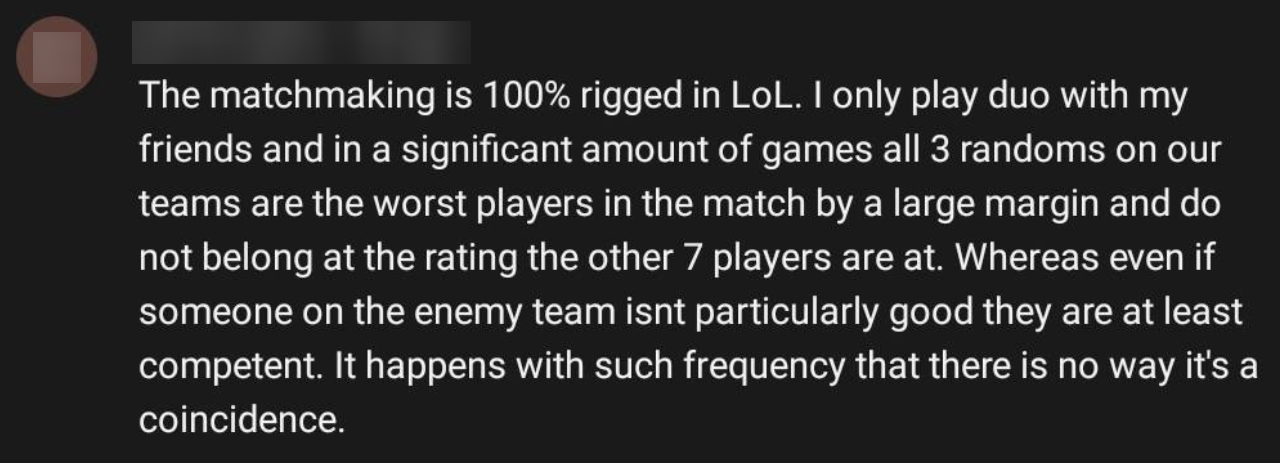
There are about 500 cute one-liner gotchas that contradict this belief. True believers are immune to all of them—and why shouldn’t they be? They spend far more time considering this stuff than the average player, sometimes cross-checking K/Ds and rating brackets and spreadsheets of game results, occasionally pointing to that one really weird 2017 research paper about “Engagement Optimized Matchmaking” with five EA employees on the byline. (What the fuck?1)
Matchmaking produces bad results pretty often, because it’s a hard problem. When I queue with my housemates in Deadlock, the matchmaker has to somehow assemble a fair game around a washed-up arena shooter freak who’s only comfortable on one hero, two relative novices who don’t play shooters at all, and my dear hyperdistractible husband, who teamfights with the committed aggression of a charging bull who’s just been called every slur. It needs to pick up 8 players, 2 with us and 6 against, all of whom have their own skill disparities and constraints, and organize that into a reasonably fair game. And it needs to do so in under 10 minutes (ideally under 5!), for every player involved, or we all get bored and call it a night.
Even after doing that, it has to appear fair, or people will cry foul anyway.
So it’s no wonder that people believe A. Matchmaking, even when we do it as well as we know how to, kinda sucks sometimes. The belief in B—that the system isn’t just volatile, but structurally unfair—is where the iceberg starts, producing an entire slurry of unrefutable nightmare beliefs. You cannot tell someone that Elo hell isn’t real when their day-to-day experience is pitchforks and brimstone.

So, fuck it. I’m not even going to try; as Mark Twain once said, “you are right”. Let’s say—not just for the sake of argument, but trying for a moment to truly believe it—that Elo hell is verifiably real. Researchers did an independent study and figured out that your favorite game, yes yours, has been rigged in such a way that your rating (yours specifically!) will always be two standard deviations below where it should be.
Where do we go from here?
part I: please fuckign get out of ranked i am being so deathly serious right now just delete your computer and walk away
If the competition is illegitimate, there’s no reason to care about the outcome. Just play the game with your friends and have fun.
[…]
…Yeah, there are a few reasons that’s not a satisfying answer. Nobody gets into games because they’re motivated by a…fucking leaderboard. We play the game because the game is fun, and we aspire to top-level play because top-level play looks exciting or expressive or interesting; ranked play is the mechanism we use to get there.
That’s my favorite set ever recorded, not just becuase Isai manipulates the camera to back his opponent into an off-screen tornado—though, like, make a note of that—but because it’s the set that “opened my eyes” to competition play, the idea that there’s a higher summit to reach than just beating my annoying friend who plays Pikachu. 15-ish years later, when I’m done getting my feet wet in a new game, I always poke my head into tournament footage or the top of the leaderboard, wondering what people are up to that I wasn’t able to find on my own—that’s fun, and what I find is cool! Improving and learning and exploring is fucking based, actually!
So it sure seems normal to want a high rank, and to get frustrated when that process is slow and stuttering. The coolest parts of the game are further up the ladder; nobody wants to get stuck in low-skill unorganized games where interactions come down to dipshit coinflips and whether your teammates plugged in their monitors this morning.
…You know what my second favorite set is?
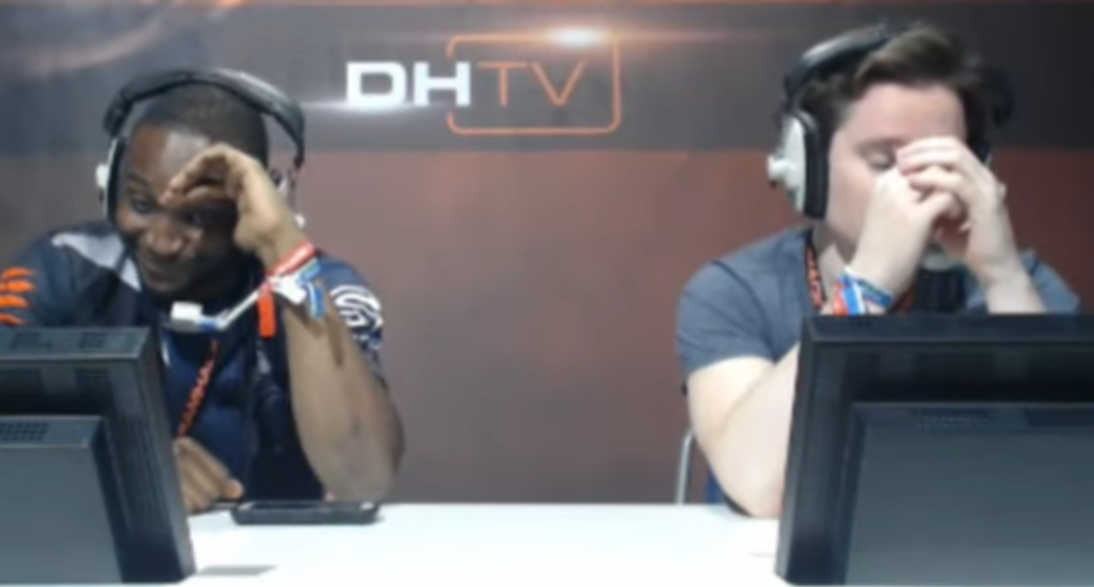
I don’t have anything against FSP here, not really, but it’s fun to root against him. On one hand, we have the guy playing the conventionally strong character in conventionally strong ways. On the other, we have Gandhi, Dipshit Ryu Supreme, who doesn’t care whether his attacks get blocked or not because he’s going to press Shoryuken anyway. I admire his spirit.
Gandhi makes terrible decisions with abysmal EV, throws away guaranteed opportunities as often as he takes them, and generally plays like a dumb asshole. FSP, who almost certainly knows more about Street Fighter IV than his opponent, makes better choices at worse times, or makes costly mechanical errors during otherwise good situations, and gets ripped apart on a livestream for the crime of trying to play Real Street Fighter.
He takes it pretty well.
This all happens without a matchmaker or rating system ever being involved; it’s just the way games work in competition settings. The standards and practices of The Pros are tools to maximize your positive outcomes, not HOA bylaws, and there will always be some room to break them if you can dodge the punishment (or the punishment simply never arrives). You have to climb far, sometimes out of solo-queue reach, before it ever becomes safe to take them as a given—and even then, sometimes there’s something anyway.
As you claw your way out of the shitpit, it’s worth developing some resistance to this sort of thing. What you find at the top may be another larger hole, but if it’s not, you might still find that sensible play can lead to strange places.
Even if you’re not a Matchmaking Truther this paper kinda sucks ↩︎