Like Dreamer is, somehow, actually good

I think most people will forgive me for my first impressions of Like Dreamer. The Steam trailer’s sedate-looking shooting, polite “future something” soundtrack, and the Busty Heroine Sidebar immediately painted a picture of a very specific type of game. If you don’t know the kind, you can take an educated guess.
But I’m a pretty relaxed person about that kind of stuff, and good aesthetic ideas can be found in strange places1—and I’ve been on a shmup kick anyway, trying to develop my taste and load up on airport distractions for an upcoming trip. “Sure,” I said to myself, clueless. “Let’s give it a go, and I’ll try not to set my expectations anywhere in particular.”
You thought you were going to play some toothless eroge-lite doujin bullshit? Well, great news: you’re actually playing a different kind of doujin bullshit, idiot!
Like Dreamer doesn’t really have a unique mechanical gimmick or gameplay hook. Instead, it’s mostly interested in Shooting Good (Regular), in a way that produced a glowing feeling but makes it hard to write a glowing review. I’m gonna try, though, because I really do like this thing; I think it comes down to pacing.
Games have had cycles of tension and release since…fuckin, uh, Space Invaders probably,2 with rising and falling difficulty defining windows of intensity. We’ve gotten pretty good at tuning and layering those timings to precisely control tone and mood and stress, for good and for evil, but we’re not perfect yet; sometimes games ask you to sit on your hands, overwhelm you into disassociation, or demand an attendance-check for what seems to be no specific reason. Sometimes those mismatched periods are long and easy to identify, but sometimes they’re really short, and produce a feeling that’s hard to quantify as anything but “eh, not feeling it”.
Like Dreamer has it figured out; almost every time it introduced a new challenge, it came a quarter of a second after I had gotten comfortable with the last one. Patterns constantly shift and fuse, box you in and push you out, in novel ways that make every boss feel like the best attractions at a theme park. There’s not much flashy artifice here, just really good tuning and an obvious appreciation for the prior work; it’s a good French vanilla, maybe with a little of that chocolate quick-freeze stuff on top. You move fun and bullet goodly.
Like Dreamer’s approach to difficulty is best described as “have fun and be yourself”. Resources are abundant,3 a permissive autobomb guarantees you can use all of them,4 and every hitbox has been shaved down far beyond its visuals, encouraging you to dart through danger and pray rather than freezing up. The stage portions scroll slowly, making it hard to get a large enemy stuck halfway down the screen, and bosses call their more lethal shots with accelerating bullets or a sharp sound cue.
But bombs don’t deal much damage, and don’t give you much time to get comfortable; you’re given a lot of room to mess up, but when you do, the game doesn’t patronize you by backing off.5 If you have a rough time with repetition, or feel stuck in an awkward difficulty pit but want more structure than Free Play, Like Dreamer will treat you well—even if some of the stuff it lets you get away with feels kinda goofy.
Instead of constantly trying to ruin your life, Like Dreamer introduces a straightforward incentive for the player to ruin their own life: pointblanking. Sticking close to enemies deals extra damage, scores better, and generates more bombs, which can be used for scoring by cancelling bullets.
Here, the resource safety-net (and the lack of contact-damage) nudges players into chasing high scores and extra lives, burning those abundant resources by choice. It breaks up the tap-tap left-to-right rhythm of stages, constantly pushing you down the screen only to coax you in again—welcome spice in the easier early stages.
I am contractually obligated to complain about something, and it took me no effort to pick that thing; I don’t like Like Dreamer’s unlockables. The main gameplay mode treats every stage as a standalone run, and after defeating all 8 stages, then you’re permitted to play a full-game run—except it’s actually an abbreviated run that skips certain stages. Clearing that unlocks a boss rush and Extra Stage,6 and clearing the boss rush unlocks a revenge bullet switch and the real full-game run.
All of this, I could forgive (even the hidden “Nightmare” and “Chaos” difficulties), if only because Expert mode happened to be really well-matched to my current skill. But there’s one more unlockable mode; “Speed Run” mode, which is a full run where stages scroll faster the fewer enemies are alive. It is delightful, easily my favorite way to play the game, skipping over downtime and giving the forgiving enemy pacing some major teeth—and you unlock it after all of those.
:/
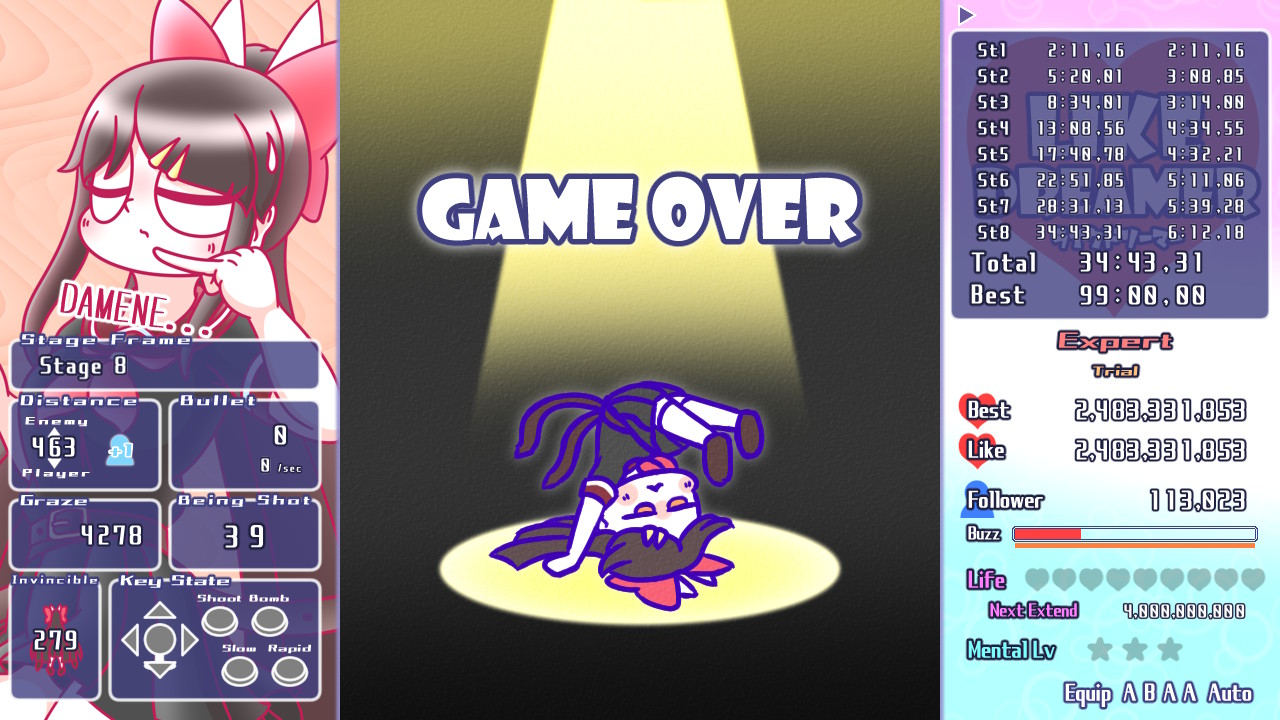
I accept this as largely a personal hangup; for people without imported Arcade Expectations, the unlock structure probably helps them build skills instead of uselessly grinding above their level. There are three difficulties available from the start, and all of them seem to be actual video games, rather than the typical arcade-port Novice mode where the hardest part is learning how to hold the controller; forcing players into single-stage play shields them from failure while still giving them an enjoyable challenge.
I begrudgingly accept this as useful and valid. But it does seem like a bit of a snub to force superplayers to do, like, five full-game runs to unlock something that meets them where they are. Once again, I beg for the “I am not motivated by progression systems” switch in the options menu.
I still have no idea what the function of the Busty Heroine Sidebar is, but I can’t guarantee I would have clicked on this if I hadn’t raised my eyebrow at her; if that’s the strategy, it worked on me. But regardless, the process that created the Busty Heroine Sidebar also made the rest of Like Dreamer. I see no reason to complain.
This is a post about arcade strip mahjong. ↩︎
more: “Nishikado motion” ↩︎
“you can take 40 hits in a full-game run” abundant, somehow catapulting it beyond Mecha Ritz: Steel Rondo in terms of how much dipshittery it’s prepared to tolerate ↩︎
Tangent: I’ve been playing a lot of shmups recently for the specific purpose of learning to manual bomb, so this was pretty funny to me. You can customize your character before a run, and your overall “shot style” controls autobomb behavior: the default type-A gives you autobombs that only deplete 1 bomb. Type-B and type-C boost a shot type in exchange for autobombs dumping your whole bomb stock, and type-D boosts both shots but disables autobomb completely.
Autobombs also count as “hits” for TLB eligibility, but manual bombs don’t. Yet another reason to kick my habit… ↩︎
There’s also no rank system, at least according to the info window? If you take a death in a tough fight, Like Dreamer is happy to keep killing you. ↩︎
And the Info Window—the gadgets on the left in some of these clips. Which is really funny, because the information it provides really isn’t that useful for routing or system plumbing—it’s effectively a switch to cover up the girls. ↩︎