There are no hard multiplayer games, BUT...
An interesting video recently crossed my desk, by YouTube user “The fog is your friend” (hereafter “Fog”). This is a response to it, so you should probably watch it before reading—it’s only, like, 15 minutes.
Do not comment on this video if you didn’t watch it I swear to god. Fog seems to be a well-meaning person operating a small channel of limited influence, and their apparent goal is to increase the amount that people use their brains when discussing video games. They are an ally in the Discourse Wars.
This is an excuse for me to speak up, not an attempt to push someone down.
recap 🔗
As a refresher, I’ll try to summarize Fog’s take as charitably and accurately as possible:
- Because both participants in a game are subject to the same rules, adding or removing obstacles doesn’t change the game’s difficulty; it only changes the tested skillset. The performance of your opponent “sets” the difficulty.
- Games have an “action-to-decision ratio”, describing the number of actions required to realize a single strategic choice. High action-to-decision ratios lower strategic depth, reduce the skillset emphasis on strategy, reduce meaningful player interactions, decrease strategic variety, and reduce spectator legibility.
- Certain types of players arbitrarily believe that “harder” games are better; these beliefs conflate “tedium”, “inaccessibility”, “difficulty”, and “complexity”, rolling them into one shadowy umbrella term that can then be privileged as a metric even though it’s meaningless in multiplayer contexts.
- These players privilege certain types of tedium and inaccessibility based on what they’re used to and have already acclimated to, rather than what makes sense or is best for a game; if these chores didn’t exist in prior games, no one would reinvent them.
- Not every mechanical skill should be eliminated from every game, but they must justify themselves by being “fun to do and fun to compete in”. Making the game “harder” is insufficient justification; “hard” is a meaningless shadow term and not inherently good.
I have done my best to be complete and concise here, but the actual forms of these arguments involve several special definitions of words and a lot of unstated assumptions, and I think going over those exhaustively makes the recap hard to follow—so this is the charitable version. I’ll try to get to it down there.
Fog’s eventual conclusion looks like this (direct quote):
The obsession with wanting games to be as “hard” as possible handicaps the entire RTS genre—not because it doesn’t cater enough to casual players, but because mechanical barriers make these games less interesting and less deep. […] Each individual decision should ideally be as simple to carry out as moving a chess piece. The only exception is when a mechanic in itself is generally fun to do.
what are we doing here
Fog’s video is made with RTS games in mind, and that’s not my genre of choice, so I’ll just assume that these arguments are salient and relevant to RTS communities and their ongoing discussion. Gamers are shitbirds and largely allergic to any view of design that doesn’t accomodate their neurotransmitters. It is known.
However, these arguments are phrased and presented in a pretty broad way, reaching beyond RTS games. In some cases they seem weakly justified, in other cases they seem to elide a lot of meaningful complexity, and they seem to stomp on some players (even RTS players!) who have well-constructed reasons for liking what they like.
I want to talk about that and make my own case for friction, and I promise I won’t say the words “motion inputs” once.
part I: the pie chart model of challenge 🔗
Fog correctly points out that the practical difficulty of a multiplayer game (at least, the symmetrical ones) is determined by your opponent, not by the provided obstacles. Adding hurdles to the 100-meter dash might make you slower, but your opponent also becomes slower; you now need to do hurdles, sure, but it’s not inherently harder to win.
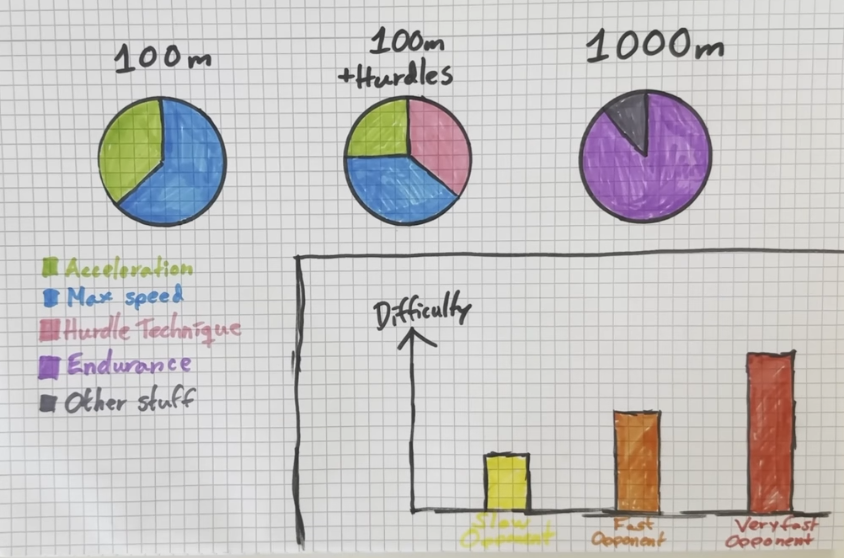
But, like…when you add an obstacle, you’re doing something to the difficulty, aren’t you?
Counter-Strike, a tactical shooter with myriad complexities to strategy and basic execution, is harder than Samurai Kirby, a reaction-test minigame. In both cases, the difficulty is determined by your opponent, but you can only get better at Samurai Kirby by reacting faster. Counter-Strike allows for stronger opponents; there are more ways a player can become strong and exert control over the game state.
Counter-Strike is harder than Mario Party, a digital board game famous for its randomness. Mario Party’s strategy space is still larger than Samurai Kirby—there are more ways for a player to become strong—but their strength is filtered through the game systems and regularly made irrelevant. The best player in the world could arbitrarily lose to a novice.
These examples are leaky and incomplete, and they don’t prove a lot. I am 31 years old, and if I play Samurai Kirby against a 16-year-old with an Adderall prescription, my games will be insurmountably difficult; this maps better to Fog’s definition than our intuition, and I agree that “hard” versus “easy” is a lossy and unfortunate way to frame this. (In particular, I think that framing mutiplayer games as “really hard” can scare away potential players who would otherwise enjoy themselves!)
However, I think they still point to something: the pie chart model of challenge doesn’t capture everything we care about.
While adding obstacles doesn’t increase the difficulty of an individual match, it can have a meaningful impact on a player’s experience of improvement and competition. It controls the skill range of possible opponents, the peak difficulty of a match, and the processes involved in getting there.
To my mild frustration, we have probably already lost this fight. The words “challenge” and “difficulty” and “obstacle” and “competition” are a semantic slurry now, and we need to use a new phrase or word for this idea; this concept of “hard” and “easy” multiplayer games persists because people find it useful.
But maybe we can bring this into the conversation a bit. Instead of gesturing at a specific game being “hard”, maybe we can talk about its “peak challenge”, to try and avoid scaring people off?
(We’ve already burnt out “skill ceiling”, can’t use that one.)
part II: the tree in the forest 🔗
Fog carries the pie-chart model forward.
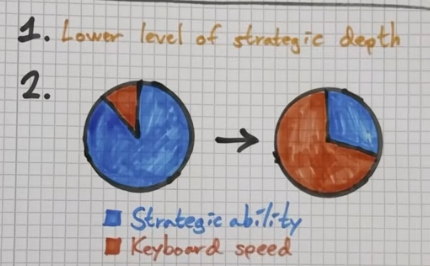
The end result of a high action-to-decision ratio is that players use simpler strategies and play at a lower strategic level, because they can’t make as many of the decisions they want to make [emphasis mine]. The focus of the competition also shifts from being about who can make the best decisions to who can execute the most actions.
There’s a subtle but important difference between these two points. A high action-to-decision ratio not only divides the measured skill between strategic ability and keyboard speed. It also bottlenecks your strategic ability behind your keyboard speed, effectively lowering your strategic skill.
Let’s imagine an RTS where every time you click your mouse, the game requires you to hit the G key on your keyboard. If you don’t hit G, your mouse click doesn’t do anything.
This is a straightforward multiplier to the action-to-decision ratio that has minimal implications on the rest of the game, a platonically perfect “garbage input”. If it was added in a patch, the playerbase would justifiably revolt. It sucks.
In this case, I am completely in agreement with Fog on point 2. The “G patch” would cause fewer matches to be decided by strategy, and more matches to be decided by a difference in ability to press the G key.
But…does it actually reduce the game’s strategic depth?
I don’t think it does, and I’m not sure why Fog seems to disagree. Strategy is less comparatively important, sure, and players under mechanical pressure from the G key will likely drop some balls regarding information or decision-making; a player with better “G-cancels” might beat a player with better strategy.
But the underlying strategy space is unchanged; every decision that was previously available is still available. When top players inevitably learn to “G-cancel” with the ease of breathing, it might very well be like nothing changed at all.
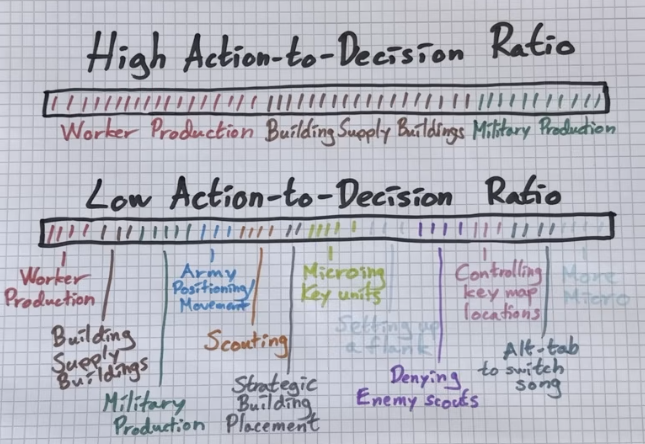
Fog briefly reframes this as a problem of “decision density” (my term not theirs), asserting that players under more mechanical pressure make fewer decisions because they’re busy doing mechanical make-work. This may very well be true, although I don’t think it has to be; multitasking (or the appearance of multitasking) is a trainable skill, and pretty interesting to test.
But while it can affect an individual player’s strategy, it doesn’t affect reachable strategic area unless the mechanical demands are, like, pushing the physiological limits of human biology, and they’re tuned to be stronger than using the equivalent effort on better strategy (which seems like…a way deeper design problem). Maybe this framing makes more sense within the established grammar of RTS games, but it seems unconvincing.
G-canceling still sucks ass. But it sucks for reasons that, from what I can tell, have very little to do with strategy.
part III: single-player mode 🔗
Okay, now I get to work my way along to the full list. Let’s talk about #3 here (and #4 can slide in too):
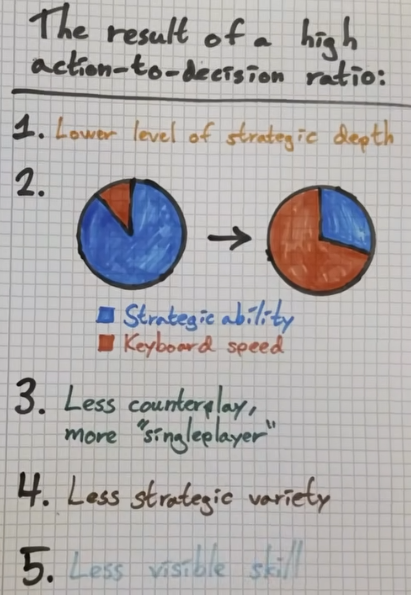
A high action-to-decision ratio leads to less possible counterplay as well, because instead of players strategizing and microing against each other, the gameplay revolves more around each player overcoming single player style obstacles, separately from the opponent. [emphasis mine]
An analogy would be playing Mario Kart against someone else, but instead of racing each other on split-screen, you take turns doing time trials to see who gets the best time, without much interactivity with your opponent.
I think this is a cute analogy, but like all such analogies, it erodes a lot of complexity that’s worth talking about. Obviously the solution is to employ my own hypothetical!
Imagine Street Fighter, but slowed down by 90%; when 1 second passes in the original game, 10 seconds pass in our thought-experiment. The pie-chart model of challenge tells us that this should redistribute importance away from fast inputs and reaction times, and towards strategy. 15-frame overheads can be tough to block, but 150-frame overheads are slow enough that you can RSVP.
However, Fog’s framing also tells us that the strategic depth should increase, since there’s less emphasis on mechanical skill, and…it doesn’t. Entire categories of action disappear, since they’re trivially punishable every time, or give up advantage in a way that relies on the game’s timing. Any situation that hinges on asymmetrical reaction (“I already know what I’m gonna do, but you have to guess or react”) falls apart. Fewer decisions are useful. The strategic depth, real and impactful at full speed, decreases.
So clearly Fog’s model doesn’t account for everything—and this makes sense, I’m not here to bash them for my goofy gotcha example. The dude is clearly talking about this through the lens of RTS games, where you control a million guys who can all be doing their own thing in a largely continuous way. In Street Fighter, you control Ryu, whose moves are tuned around human reaction windows, and once he throws a fireball you’re dealing with the impact of that choice for a while.
But I think it’s still worth pointing out. Fog tells us that mechanical burdens make the game less interactive, but Street Fighter’s interactions are all held up by its timing and execution checks. For something like this to work, it would need to add more strategic levers, replace timing-based choices with hidden-information based choices, discretize actions to create committment and opportunity cost…uh, basically it would need to be YOMI Hustle.
I think the same sort of thing can apply even in RTS games. If your opponent is distracted with mechanical busywork, they might miss a scouting intrusion or a surprise attack, maneuvers that they would have easily swatted away otherwise; mechanical burdens make those maneuvers viable. In general, when things are competing for your attention and dexterity, you have to choose which plates to keep spinning, which can create interesting opportunity-costs and decision points.
Put simply: sometimes, mechanical challenges create strategically interesting situations or variance, and prevent players from reaching solved gamestates. Not always: you have to be careful that they don’t create perverse or overcentralizing patterns of their own. But they’re a valuable tool to have in the design playbook.
part DANGER: “accessibility” 🔗
Up until this point, my observations have been largely about a way of thinking: generalize Fog’s arguments too far, and you either have to carve out increasingly erudite exceptions, or arrive at a moon-logic viewpoint where Tic-Tac-Toe is more strategically complex than StarCraft.
This is the section that I’m sort of nervous about writing and most receptive to pushback in, because it’s about a way of acting.
It’s about the way we use the word “accessibility” in games.
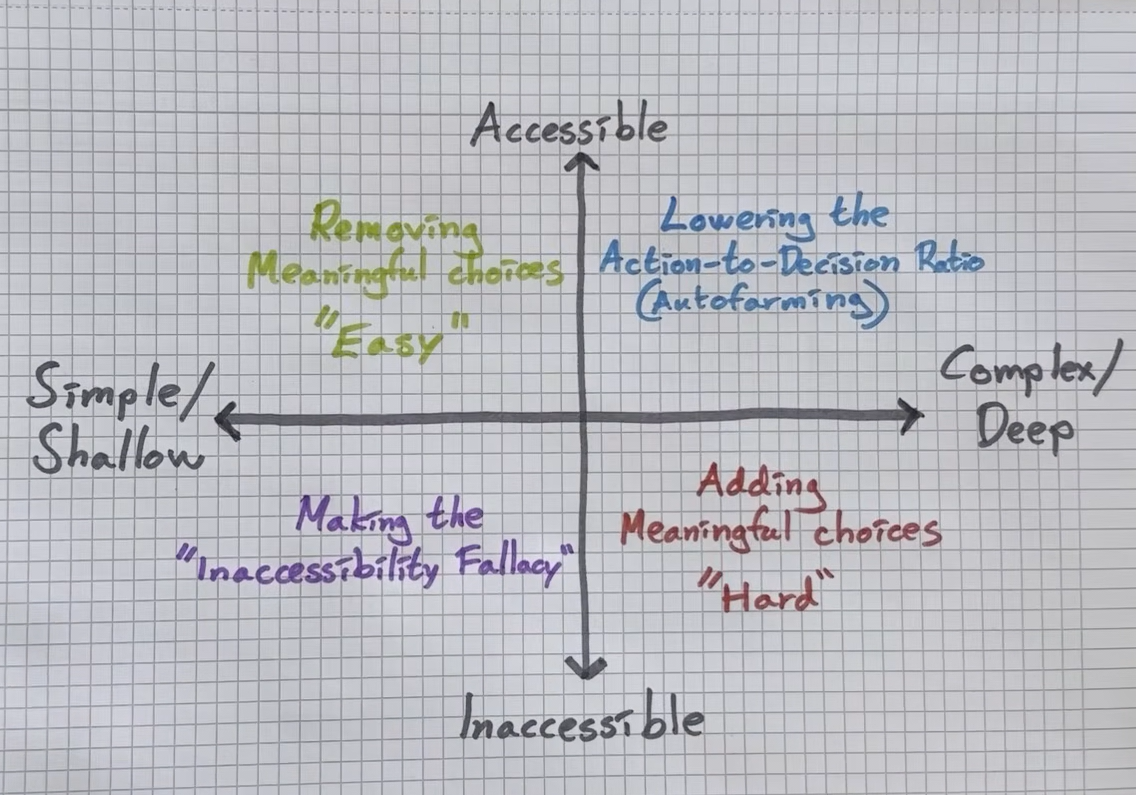
Fog points out the way that “RTS elitists” conflate different terms into the meaningless umbrella of “hard”, and there’s an extent to which I agree. I find it tiresome when people argue for the status quo with nothing substantive, with the classic “git gud”. I think we should probably promote people saying what they mean, and meaning something more substantial than “I think my ability to overcome arbitrary toy challenges makes me better than you”.
But if this semantic collision sucks, then can we meet halfway on another word?
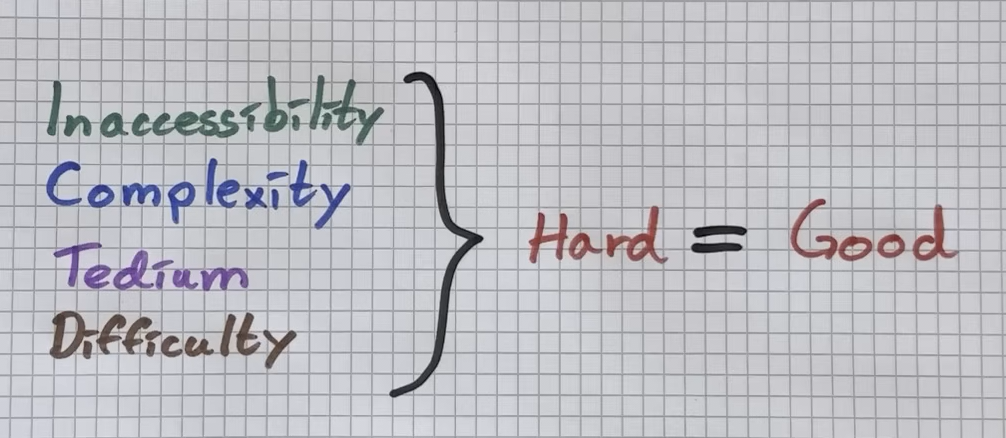
“Accessibility” has been commandeered and conflated to mean everything from “needlessly exclusionary” to “I disagree with the intended level of challenge” to “biologically unfair” to “I have to practice to achieve a specific result and I don’t like that”. It blows, it’s confusing, and it lends undue legitimacy to the shallowest and laziest kinds of critique, the ones turning every video game into entertainment-product nutrient-paste.
I don’t think it’s deliberate or malicious, but I think Fog is probably guilty of this. There’s a discontinuity of thought; there are “no hard multiplayer games”, only hard opponents, but somehow when mechanical skill and “accessibility” are involved, “inaccessibility” is an inherent quality of the game—as if Age of Empires 2 is going to crash to desktop if you’re too slow to place your farm. It isn’t.
It’s not inaccessible! You can…fucking…access it?!
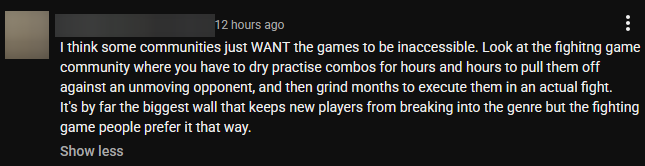
If the difficulty is determined by your opponent, then…you don’t inherently have to do any of this. This definition of “accessibility” is about an arbitrary set of expectations, about the unspoken assumption that opting into optimal competition is the only legitimate mode of play. I find it distasteful, because it can be used to point at any system that creates a challenge or obstruction, point out that the game is asking literally anything of the player, and render that illegitimate through a linguistic magic trick.
When we use the word “accessibility” for this, when we conflate it with photosensitivity toggles and alternate button-hold controls, who benefits?
part v: artificial fun 🔗
Mechanical skills have a place in games and sports if they’re fun to do. RTS games also include some level of mechanical skill, which lowers the strategic depth and reduces the focus on strategy. But if these mechanical skills are fun to do and fun to compete in, then they should, of course, be in the game.
Great. Now who gets to decide what’s fun and what’s tedious?
I think this part of the video confuses me the most. Fog creates a dichotomy between “fun” and “tedious” mechanical tasks, exalts one while defaming the other, and then…just…moves the needle to an arbitrary location to put things they like on one side and things they dislike on the other.
The best option I have to approach this still doesn’t feel very charitable, and it’s circling around my root issue with this video. Fog appears to have identified an area of fuzzy semantic overlap (“multiplayer games can’t be inherently hard”), noticed this overlap in action while people talk about their taste (“I think Age of Empires is timeless because it’s hard”), and instead of granting them some charity in a confusing semantic situation, just…seems to have assumed that their tastes are based on a logic error.
Like, I don’t know, dude! Maybe they authentically like the things that they say they like! Maybe they’re human beings with interiority and the ability to observe the difference between neurotransmitters that make them feel good and neurotransmitters that make them feel bad!
Fog seems completely unaware of this possibility, and spends most of the video drawing logic diagrams around a group of people that they don’t seem to understand or respect. This is an extraordinarily low-stakes issue, and I don’t want to tar-and-feather someone over guys we mutually made up in a video game discussion. But this is weird, right?
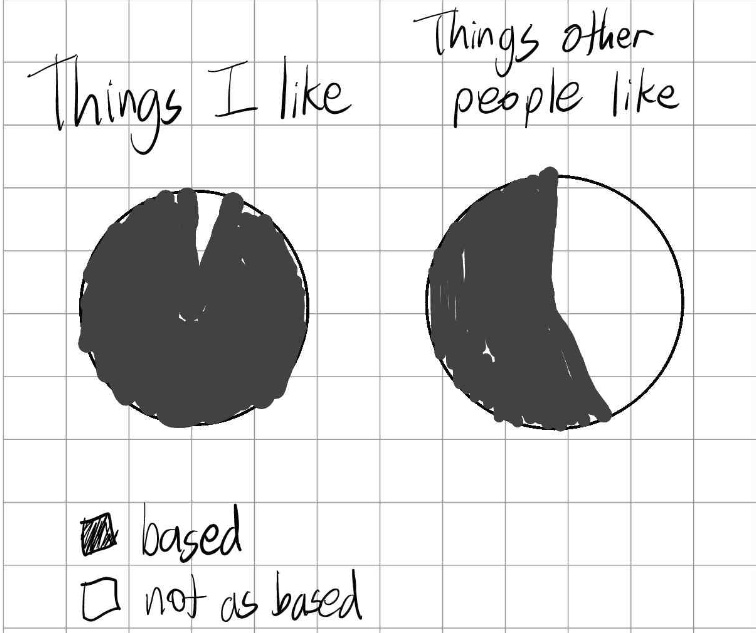
It seems easy to treat this entire thing like an act of backward reasoning: “no one could possibly like something I hate so much, and by golly I’m going to find out why they think they do.” But I’ve been in positions like this before, in love with a game or hobby but flabbergasted by the community; basically every time I click on a Reddit post, I see someone glued to the top with a billion upvotes, advocating for design that makes me rub my eyes in exhaustion. Why is it that the loudest people are always so goddamn thoughtless?
I think it’s better to just treat the whole affair as an act of good-natured passion. My best guess is that Fog got tired of thought-terminating non-discussion surrounding the things they care about—led by the sort of nagging no-changes-ever types that seem to constantly be trying to push back as developers push genres forward—and made an inexact argument for a viewpoint they feel strongly about, frustrated that no one was talking about it.
final 🔗
Mechanical execution tasks aren’t inherently at odds with strategy; at their best, they inform and complement it, like salt and pepper on a fine cut of meat. I agree with Fog’s introduction, but straightforwardly disagree with almost everything else they say, and I have minimal clue how they got from one to the other.
(Imagine my dismay, clicking on a video called “there are no hard multiplayer games”—having believed this emphatically for years, delighted to finally see someone write the video I should have written about it—only to get spun around blindfolded for 15 minutes by someone who shares exactly one of my beliefs and considers all the rest to be a logic problem.)
I scrolled the comments on Fog’s video to make sure that I wasn’t reading it in a completely wackass way, but I think I still might have stepped out of my “boundaries” a bit too far; it’s not clear to me whether this is aimed at a general audience or at RTS players, but the title definitely makes a broad statement about all “multiplayer games”, so I’m treating it like a general-audience video. If there’s RTS-specific nuance that I don’t understand and that makes me a donkey, sorry.
I don’t really do “reaction” or “response” content, and I feel sort of nervous about publishing this. If you’ve made it all the way to the bottom, I’d like to ask again that you…
- watch the entire video with an open mind before commenting
- treat everything I say with the same credulity as the video I’m responding to, and judge the arguments on their merit
- be nice to Fog, their video is better than the median game design video
The timer in blitz chess is a mechanical maintenance task in exactly the same way that worker queueing is, and in environments that allow for premoves, the mechanical burden introduces the new strategic option of playing forcing lines for clock advantage. Thank you for reading.