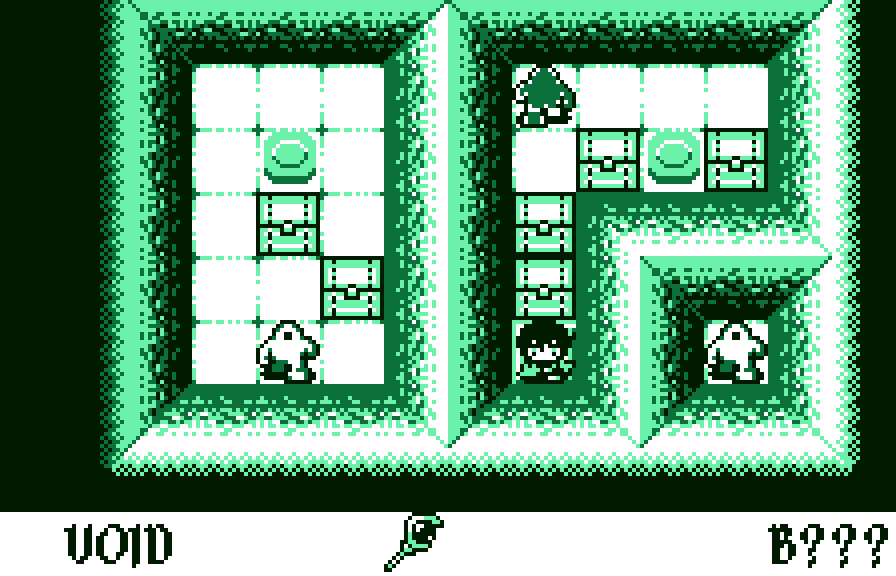
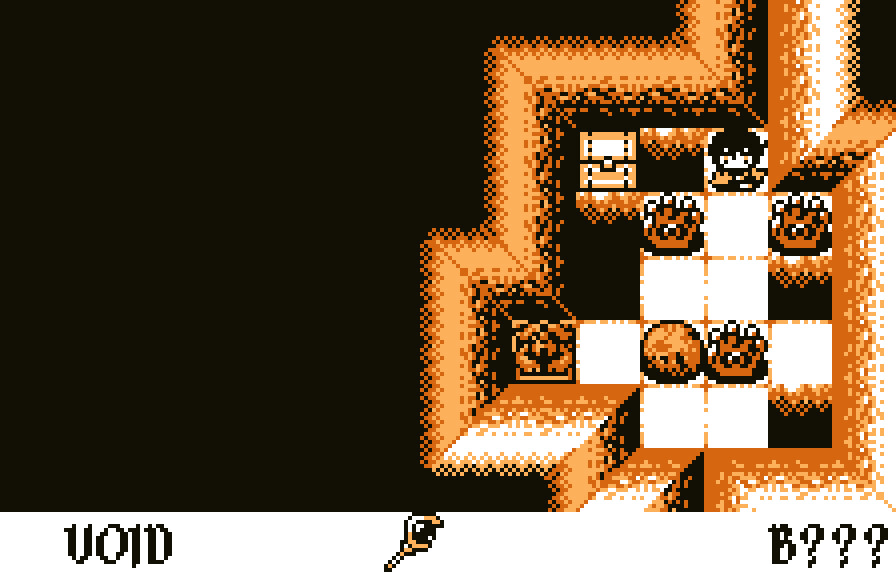
You should play Void Stranger
I admire Void Stranger’s restraint. It’s quiet, austere, at times dry and unfriendly. It often seemed like it had forgotten about me entirely—that it had been made without any pretense the player would even be there.
That’s not true, of course; that feeling is engineered, cultivated with great care and a respect for the player’s mind and motivation. I found Void Stranger immensely rewarding, but that reward was rarely a gold-star sticker and a pat on the back. Instead, it would be the satisfaction of the “click” moment, a new way of thinking about problems, some trick or technique that made the game’s single-screen puzzles suddenly feel bigger—and then it would be a new puzzle, presented entirely without ceremony and eliciting the same “alright, let’s see what the hell we’ve got” reaction as the last.
I don’t think of myself as a Puzzle Game Person; I’ve spent most of my life getting thrashed at chess and stuck in RPG dungeons, fumbling and feeling a little embarrassed whenever I come into contact with any classical signifier of intelligence, something people expect me to be good at. But I grew into Void Stranger’s puzzles, and they grew with me, constantly pushing the limits of my creativity but rarely requiring grindy turn-by-turn calculation. I found them easy to love; on hot streaks, I’d return to the grid for two, three, five sessions in a day, convinced that I knew what I’d missed the last time I left off.
Void Stranger does, in fact, know the player is there; it sweetens the deal with an excellent soundtrack, scattered mysteries, and an immaculate vibe at once hopeful and somber. The spaces between puzzles sometimes feel like they pass too quickly; the difficulty curve gets steep just as the game starts to really cultivate your hunger for discovery, and that conflicting cocktail of emotions was a lot to handle at times, a push-pull between wanting More Game and Less Game. But I took frequent breaks, and any burdens I’d felt when leaving seemed lighter when I returned; often, a room that resisted my efforts for half an hour would snap into place instantly. If you could bottle my emotions in those moments, you’d be a millionaire.
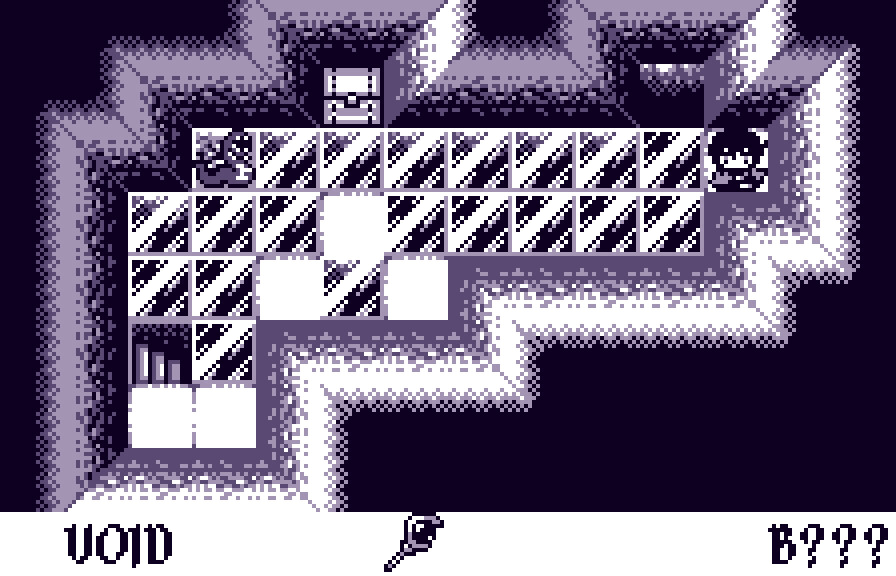
An overwhelming majority of your playtime will be spent staring at a 14x9 grid, certain that what you’re being asked to do is impossible, and trying to do it anyway. I think it was good for me.
Why I played Void Stranger
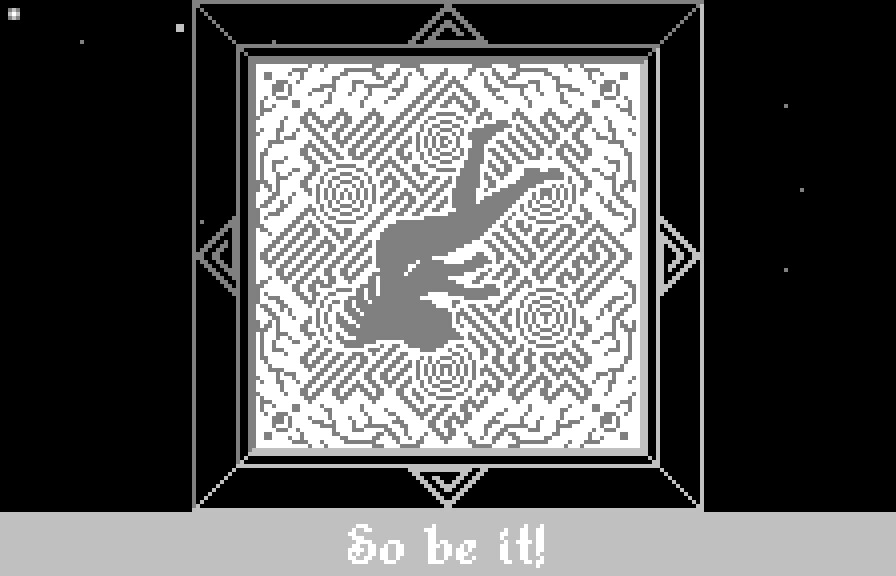
Void Stranger’s Steam page intentionally omits its core mechanic; the ability to pick up and place floor tiles. You unlock this about 30 seconds into gameplay; you open a chest, The Rod comes out, and the game patiently waits for you to bridge a gap with it before the actual gameplay starts.
The Rod is the primary thing driving Void Stranger’s design space, and that space is vast. At the game’s outset, using it felt like working an unfamiliar muscle, slowly rewiring my brain to treat “floor” and “hole” as permeable categories; by the end, I’d built up a network of mental scaffolding that operated beneath the level of language, an intuition for how rooms could be melted down and made to flow like water.
Void Stranger grows with you in this regard. By the time you work out how to do any number of Really Powerful Things, the game is probably prepared for you to do it; the Rod is not a level-editor, and when it interacts with enemies and obstacles, it can generate a limitless number of dead-end red-herring non-solutions. In that way, puzzles are resistant to panicked flailing or mechanical bruteforcing; often the “click” moment will come when you realize that you should do something or why you should do something, not how you should do it.
That depth surprised me. Void Stranger’s endgame puzzles have a fiendish variety—wide-open headscratchers, tight prescriptive prison-cells, monster-houses, formless voids—and almost all of them delivered a novel challenge, despite sharing a fairly narrow palette of obstacles and enemies. The effort and time required to see everything was sometimes draining, but was rarely boring; by the end, that limited palette felt fully explored, and I was exhausted in the same way you might be after a good workout.
Why I kept playing Void Stranger
If a puzzle seems impossible, get some rest
If that doesn’t help, try asking someone for help—Void Stranger’s Steam pageDiscussing secrets is inherently difficult. I’m going to loosen my tongue a little here, since if you’ve clicked into this section, you’re either not sold yet and I have nothing to lose, or you’ve played the game yourself, and you’re hungry to connect with someone else’s experience.
I relate to that hunger; in part, I’m writing this to sate myself.
Void Stranger has a lot of things worth discovering, some emergent and some deliberately hidden. I’m not talking about the type of consequence-free “deep lore” that ends up mis-explained on TVTropes later, though the game is happy to present plenty of narrative questions. I’m talking about stuff that dropped me into a dizzy, drunken haze, watching the design space seem to expand in all directions simultaneously and wondering “can the game live up to what I just invented in my head?”
For those devoted enough to look, Void Stranger provides a lot to find—enough that it became hard to talk about the game. Discoveries can happen in any order, frustrating attempts to spoiler-tag or manage information, and range in scope from “small hint” to “new mystery” to “feeling of power and mounting confusion that I will later use as a reference point for what hard drugs probably feel like”.
There are incredible high points on this journey, but they sometimes come paired with a lonely feeling of “where next?” Mistaken leaps in logic, missing information, or simple mechanical errors can lead to what feels like a lot of downtime and repetition, or wandering without a specific objective.
I don’t get mad at games, but I can sometimes get anxious. Long stretches of my playtime were spent planning, hoping, wondering how long it would take me to Get It—sometimes wondering if I was on the wrong track, if I’d wasted an afternoon on a fruitless lead, if I would ever Get It. And while I usually figured it out in the end, I didn’t solve everything on my own; one particular hint defeated every attempt I made to decode it (and every nudge my friends gave me), for long enough that it outlived the entire construction process of my house. When I caved and looked for help online, the guide I checked admitted to using a different guide.
But I never felt like I had stepped out of the design, or that Void Stranger had left me behind; it was content to keep me company and acknowledge my curiosity, to reward me in small ways for small improvements in clarity of thought and purpose. Void Stranger gave me the opportunity to step back and just…sit with those emotions, to process them slowly without pressure or judgement, in the same way that horror movies ease us safely through fear. I came to appreciate that space, and it sweetened everything that came after.
Why I play games
What are games for?
I’m older than I should be at 30, and I’ve soured on what feels like the modern tradition of game design—the smoke-and-mirrors act of creating a synthetic problem and patiently handholding the player through solving it, while pretending that you’re not helping them. That last part is the important part. I think it has a tendency to produce an annoying type of unfulfilled person. Separately from that, it just…makes me feel weird.
Slowly, without noticing it, I’ve become frustrated by the idea of compulsory success; if I’m going to win anyway, if you’re going to make me win anyway, why bother with the pursuit? Why place an illusory struggle between me and the reward, if not to trick me and waste my time? And so I’ve taken refuge in failure: rhythm games with unimaginable skill ceilings, fighting games where there’s always a stronger player, raid encounters where you and seven other people log in to spend the whole night losing a little less each time. Environments where I either rise to the challenge, or lose until I do. I feel like they matter, somehow. I feel better when I’m there.
Void Stranger, despite its excellent act, knows that it has a player. It is concerned with my success. It uses visual tricks and floor layouts to direct and misdirect my attention, it introduces new elements in safe contexts and builds their complexity over time, and it even has a few interlocking failsafes for players who might not otherwise start the secret-finding process. I caught a lot of its gentle nudges, and I’m sure I missed way more.
But it’s not anxious about my failure. It’s patient. It’s quiet. It’s willing to let me stare at the same single-screen puzzle for half an hour, willing to let me permanently miss dialogue, willing to let me labor under false pretenses for an hour or a week or a year. It has a failsafe or a nudge for some situations, but for others, it has nothing to say at all—and I found that strangely freeing.
I might be embarrassed about blundering in chess, or wandering aimlessly in RPG dungeons—I should know better. But I was never embarrassed playing Void Stranger, no matter how hard things were for me.
I still don’t think of myself as a Puzzle Game Person, not yet. But I think I could become one.